
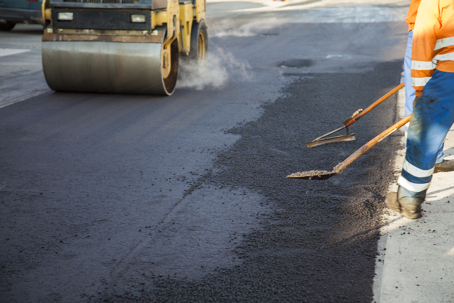
Many property owners treat asphalt as a line item on a bid, then wonder why their new parking lot starts cracking or rutting much sooner than expected. The proposal might say “asphalt paving” with a thickness and a price per square foot, and that is all they feel they can really compare. When problems show up a few summers later, it feels like bad luck instead of a preventable materials decision.
If you are planning a new commercial build in Santa Clarita or trying to fix aging pavement at an existing facility, you are probably balancing a tight budget, tenant or customer access, and pressure to get long-term value from every square foot. The type of asphalt you choose has a direct impact on how your pavement handles heat, heavy vehicles, standing water, and years of use. Once the trucks roll and the lot opens, changing that choice becomes very expensive.
At Intertex Companies, we have been building and renovating commercial and industrial properties across Santa Clarita, Los Angeles, and Kern Counties since 1982. Over those four decades, we have seen how different asphalt mixes actually perform under Southern California sun and real-world traffic on parking lots, access roads, and industrial yards. In this guide, we will share how various types of asphalt compare so you can make a more informed choice for your next project.
Dense-Graded Hot-Mix Asphalt: The Workhorse for Parking Lots and Roads
When most people picture asphalt, they are thinking of dense-graded hot-mix asphalt. This is the standard material used on many streets, highways, and commercial parking lots. At the plant, aggregates of different sizes and asphalt binder are heated and mixed, then trucked to the site and placed while hot. The aggregate gradation is designed so the smaller particles fill the gaps between larger ones, creating a dense, relatively impermeable mat once compacted.
For many Santa Clarita projects, dense-graded hot-mix is a practical and cost-effective choice. It handles general parking areas, drive aisles for passenger cars, and access roads well when it is properly designed and placed over a suitable base. Because it is widely available, most paving crews are very familiar with how to work with it, and it offers a reliable balance between upfront cost and performance in standard conditions. That is why it remains the default choice on many commercial sites.
However, standard hot-mix has limits that matter in our climate and for certain uses. In high summer heat, asphalt binder becomes softer, which can lead to rutting or shoving in areas where heavy trucks turn or brake repeatedly. If the aggregate gradation is not well matched to the expected loads, wheel paths can deform and hold water. On the other hand, if drainage is poor or the base is weak, even a good mix can crack and ravel prematurely. This is not a flaw in the material itself as much as a sign that design, base preparation, and mix choice were not aligned.
When we recommend dense-graded hot-mix on a project, we look beyond a generic specification. We consider whether the same section is appropriate across the whole site or whether truck routes, trash enclosures, or deliveries justify a thicker section or a different mix. Our experience across Los Angeles and Kern Counties has shown that targeted upgrades in a few key areas often prevent the sorts of failures owners end up patching over and over again.
High-Performance & Polymer-Modified Asphalt for Heavy Traffic Areas
Some parts of a commercial property simply work harder than others. Truck courts, loading docks, steep driveways, and tight turn areas near gates or drive-thru lanes see heavy wheel loads, slow turning movements, and sometimes standing trucks that concentrate stress in a small footprint. In Santa Clarita heat, those areas are where standard mixes tend to rut, shove, or crack first. That is where high-performance mixes, including polymer-modified asphalt, can earn their keep.
Polymer-modified asphalt uses an asphalt binder that has been enhanced with polymers to improve its stiffness at high temperatures and flexibility at lower temperatures. In everyday terms, it holds its shape better under heavy loads when the pavement surface is hot and is more resistant to cracking as it ages. Combined with an appropriate aggregate structure and thickness, these mixes are engineered to resist rutting, fatigue cracking, and surface deformation that shorten pavement life in demanding zones.
The advantages are clear in the right context. In a distribution center truck court or a loading dock lane, a polymer-modified mix can stand up better to repeated heavy axles and trailers that sit loaded through the day. It is also well suited to steep approaches where vehicles brake and accelerate in the same spot, such as parking structures or rear service drives. Over time, better rut resistance can reduce ponding water and the need for frequent patching that disrupts operations.
The tradeoff is cost and complexity. High-performance mixes generally cost more per ton and require crews who understand the specific temperature windows and compaction behavior. Using them everywhere on a property may not make financial sense, especially in low-traffic areas. That is why we often pair different asphalt strategies on the same project. We may use a polymer-modified or otherwise enhanced mix in truck lanes and high-stress zones, while placing a standard dense-graded hot-mix in employee or customer parking. This targeted approach keeps budgets under control while focusing performance where it matters most.
Porous & Permeable Asphalt: Managing Stormwater on Site
On many Southern California projects, stormwater management is as much a design driver as parking count or building footprint. Regulatory requirements and tight sites often leave limited room for surface basins or swales. Porous or permeable asphalt can be one way to handle stormwater where it falls, by allowing water to drain through the pavement into a specially designed stone reservoir below, rather than shedding it across the surface into drains.
Permeable asphalt looks similar to standard asphalt at a glance, but the aggregate gradation is different. By using more uniform, larger aggregate and less fine material, the finished surface has interconnected voids that let water pass through. Beneath the surface, the stone base is designed to temporarily store runoff and allow it to infiltrate the underlying soil, or to drain away through underdrains, depending on site conditions. When it is detailed and built correctly, this can significantly reduce surface runoff and ponding.
On Santa Clarita sites, permeable asphalt can make sense in specific applications, such as overflow parking, low-speed parking bays, or areas where codes encourage or require on-site infiltration. It can help improve usability after storms by avoiding large puddles near entries. It can also contribute to environmental and stormwater compliance goals, particularly when coordinated closely with civil engineering design.
However, permeable systems are not plug and play. They are sensitive to subgrade soils, construction practices, and ongoing maintenance. Clays or poorly draining soils may not be good candidates for full infiltration. The base must be carefully designed to carry loads without crushing, and clogged surfaces need periodic vacuum sweeping to maintain permeability. For heavy truck routes or loading docks, permeable asphalt is rarely the right primary surface. When clients ask about permeable options, we draw on our pre-construction and design-assist experience to coordinate with civil engineers and determine where, if anywhere, these systems make sense on their specific site.
Recycled Asphalt Mixes: Balancing Cost, Sustainability, and Performance
Reclaimed asphalt pavement, often shortened to RAP, is generated when old asphalt surfaces are milled or demolished and then processed for reuse. Rather than sending this material to a landfill, producers can crush and screen it, then blend it into new asphalt mixes at various percentages. RAP contributes both aggregate and aged binder to the new mix, reducing the demand for virgin materials and often improving the sustainability profile of a project.
For many commercial applications, using a reasonable percentage of RAP in dense-graded hot-mix can offer clear advantages. It can lower material costs compared to all-virgin mixes and reduce the environmental footprint of the project. When the mix design accounts for the stiffness of the reclaimed binder and the producer controls quality carefully, performance in typical parking and roadway applications can be comparable to mixes with little or no RAP.
The key is understanding that “recycled asphalt” is not a single product. There is a spectrum of RAP contents and mix designs, and pushing percentages too high without appropriate adjustments can affect low-temperature cracking resistance or workability. Very high RAP contents can make a mix stiffer, which might not be ideal in certain conditions or for thin overlays. Local plant capabilities and quality control also play a major role in how consistent these mixes are from batch to batch.
When clients are interested in sustainability targets or cost savings through recycled content, we work with reputable asphalt producers to review mix designs and confirm they meet the expected performance needs of the project. Our goal is to help owners take advantage of the economic and environmental benefits of RAP where it is appropriate, without compromising durability in high-stress areas such as truck routes or critical access drives.
Warm-Mix Asphalt: Installation Flexibility in a Busy Construction Schedule
Warm-mix asphalt is more about how the material is produced and placed than a completely different end product. By using additives or foaming technologies at the plant, warm-mix allows asphalt to be mixed, placed, and compacted at lower temperatures than traditional hot-mix. The finished pavement can perform similarly to hot-mix, but those temperature differences can offer meaningful advantages on active commercial sites.
Lower placement and compaction temperatures can make warm-mix easier to work with under certain conditions. For example, night paving or cooler morning work around Santa Clarita may benefit from the improved workability warm-mix offers, helping crews achieve good density before the material cools too much. Better compaction translates directly into fewer air voids, which generally improves long-term performance against moisture and oxidation.
From an owner’s standpoint, warm-mix can add flexibility to scheduling. It can extend the paving window on days or seasons when a traditional hot-mix might cool too quickly to compact properly. That flexibility can be valuable when coordinating around tenants, deliveries, or strict operating hours at a retail or industrial facility. In some cases, warm-mix can also reduce emissions at the plant and paver, which may be of interest on certain projects.
The considerations are availability and cost. Not every plant offers every type of warm-mix technology, and material unit prices can be somewhat higher than standard hot-mix. In our planning for commercial and industrial projects, we look at whether warm-mix can help keep a schedule on track, maintain quality during off-peak work, or support other project goals. When it is the right fit, it can be another tool to align construction means and methods with your operational needs.
How Intertex Companies Helps You Choose the Right Asphalt for Santa Clarita
Most owners, facility managers, and developers do not want to become pavement technicians. They want a parking lot or yard that works, holds up to real use, and protects the value of their property. That is where our role as a commercial contractor comes in. At Intertex Companies, we start with a complimentary estimate, but we do not stop at a simple price per square foot. We look at your traffic patterns, grades, drainage, and operational needs, then discuss which combinations of asphalt types and sections make the most sense.
Because we have delivered commercial and industrial projects across Santa Clarita, Los Angeles, and Kern Counties since 1982, our construction management team has seen what works and what tends to fail early in this region. We draw on that experience, along with input from design teams and trusted vendors, to plan paving scopes that align with your goals, schedule, and budget. Whether we are building a new facility, renovating an existing site, or completing tenant improvements, our focus is on long-term performance and clear communication so there are fewer surprises down the road.
If you are evaluating types of asphalt for an upcoming project or trying to solve recurring pavement problems, a conversation early in the planning process can save time and money later. We can walk your site, review your plans, and talk through practical options that balance mix type, structure, and phasing around your operations. To discuss your project and request a complimentary estimate, contact Intertex Companies today.